A National Pathway to market for dieback-free basic raw materials
In 2024, DWG secured a $2.4 million Saving Native Species Threat Innovation Federal Government grant.
This project will facilitate the development of marketable dieback-free basic raw materials, using innovative and scientifically validated methods of eliminating the pathogen Phytophthora cinnamomi from commonly infested substances such as laterite gravel.
Phytophthora Dieback is a key threatening process for over 230 EPBC Act-listed species. One of the major vectors for spread of dieback is the movement of infested BRM, which include gravel, sand, clays, and limestone. A key BRM use which presents dieback risk to natural landscapes is roadbuilding, for which over 8 million cubic metres of laterite gravel is used across WA alone each year.
This project received grant funding from the Australian Government Saving Native Species Program, for innovative projects, including new technologies, methods and tools, to reduce threats to threatened species and ecological communities. DWG Inc.’s project partners include the Department of Biodiversity Conservation and Attractions WA, Main Roads WA, Murdoch University, Binalup Aboriginal Corporation, Heidelberg Materials and contractors Culford Agri Industry and ArborCarbon.
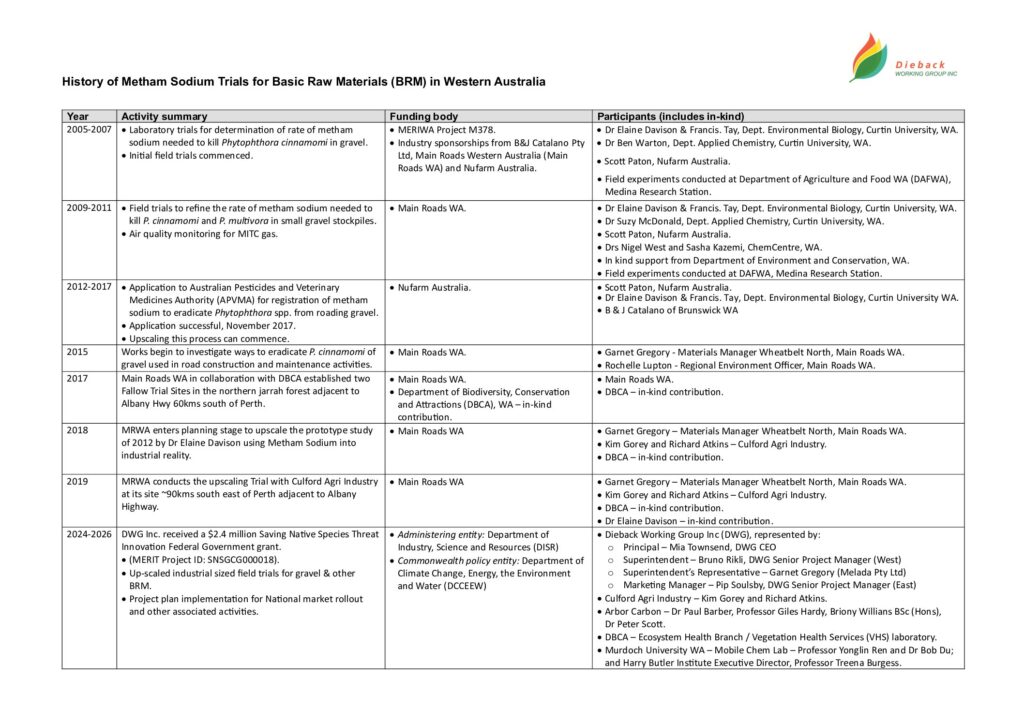
For more information on the history of Metham Sodium trials for Basic Raw Materials (BRM) in Western Australia, view our history page here.
17.02.2025
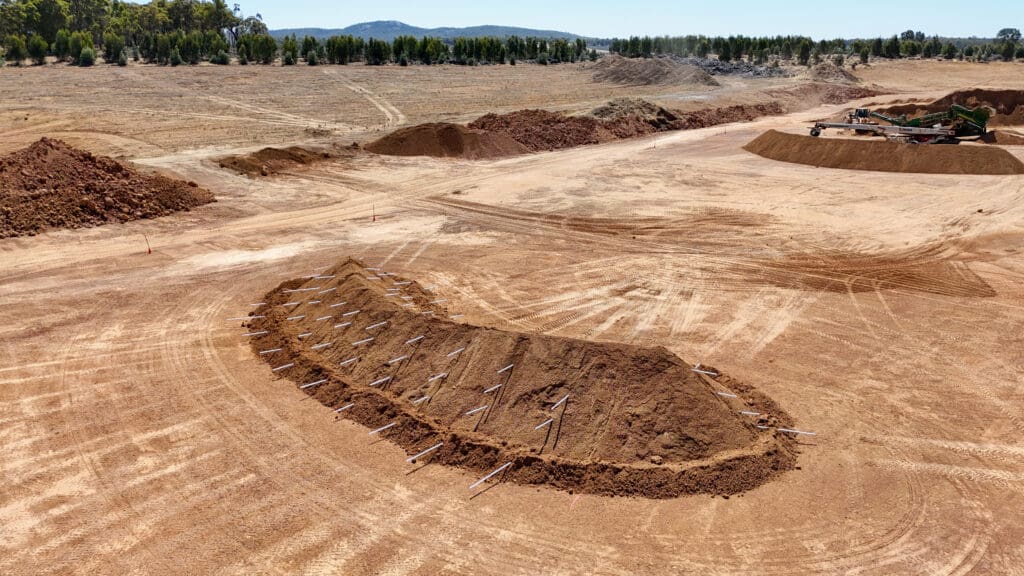
The Dieback Working Group Inc. (DWG), has secured a $2.4 million Saving Native Species Threat Innovation Federal Government grant.
The funding will be used to research, trial and promote the application of an innovative soil-fumigation methodology to mitigate the spread of Phytophthora cinnamomi, a soilborne water mould that destroys the roots of susceptible plants. Phytophthora Dieback, the plant disease caused by Phytophthora cinnamomi, is listed as a key threatening process under the Commonwealth Environment Protection and Biodiversity Conservation Act 1999, and impacts the greatest number of nationally listed threatened taxa, second only to introduced European rabbits.1 Furthermore, Phytophthora Dieback can significantly impact biodiversity, nature-based tourism, cultural heritage values and sites across a range of ecosystems.2
The construction and maintenance of Australia’s road network relies on importing basic raw materials (BRM) such as gravel and sand for essential access. If BRM used for construction contains Phytophthora cinnamomi spores they can spread and ultimately impact threatened species and ecological communities. The current process for obtaining Phytophthora Dieback-free BRM is unsustainable as it relies on clearing intact native vegetation to access the soils beneath it. Twenty years ago, Dr Elaine Davison, Research Associate of Curtin University WA, identified soil fumigation as a potential alternative to clearing native vegetation by applying metham-sodium commonly used in horticulture. A series of research trials and project partnerships followed, progressively refining this novel approach.3
The 2024-2026 project has commenced at a large scale to support its future expansion to market. DWG Inc. has assembled an expert team, established project partnerships and engaged specialist science consultants that together are currently testing the efficacy of fumigating gravel for use in civil construction. The national benefits of this project include:
- Preventing the importation of Australia’s worst introduced plant pathogen into vulnerable areas.
- Reduced need to clear intact native vegetation to source Phytophthora Dieback-free basic raw materials.
- Reducing the loss to threatened species and ecological communities caused by spreading P. cinnamomi.
- A National pathway is created to support market access to Dieback-free basic raw materials for civil road works.
- Enhanced regulatory compliance by government and proponents for construction projects requiring Phytophthora Dieback-free basic raw materials.
This project is funded by the Australian Government Saving Native Species Program, for innovative projects, including new technologies, methods and tools, to reduce threats to threatened species and ecological communities. DWG Inc.’s current project partners include the Department of Biodiversity Conservation and Attractions WA, Main Roads WA, Murdoch University Harry Butler Institute, Binalup Aboriginal Corporation, Heidelberg Materials and contractors Culford Agri Industry and ArborCarbon.
The Dieback Working Group Inc. (DWG) is Australia’s leading NfP advocate for raising awareness of best-practice Phytophthora Dieback management. DWG have been working with Government agencies, land managers, industry groups, scientists, Traditional Owners, and community members since 1996 to vastly expand the awareness, management and management practices for Phytophthora Dieback.
For further media information, please contact Pip – [email protected]