


Dieback Working Group
Dieback in the Community – Growing Awareness Around Jurien Bay

Author: Karyn Lovatsis
Over the past year and a bit, we’ve been spending quite a bit of time in and around Jurien Bay and Cervantes, talking to the local community about one of the biggest threats to WA’s unique bushland – Phytophthora Dieback.
It’s not always the easiest topic to explain. There’s the science behind the pathogen, the different ways it can spread, the plants it affects and, of course, the challenge of getting people to think about something they can’t see.
So, a big part of this project has been about getting out there, meeting people and finding different ways to talk about Dieback and help people understand how they can help protect the area.
Why Lesueur matters
Just north of Jurien Bay is Lesueur National Park – one of WA’s botanical hotspots and a really special place.
With more than 900 plant species, Lesueur is home to an incredible diversity of plants, birds, reptiles and small mammals. The vegetation provides food and habitat for all of these species, so protecting the plants of Lesueur is about much more than just protecting the plants themselves.
For a place as special as Lesueur, keeping Dieback out is really important.
Taking Dieback out into the community
Over the past year, we’ve had the opportunity to work with local residents, community groups and schools in a range of different ways.
We’ve run community events, held guided bushwalks and provided training to help people understand how Dieback moves through the landscape and what they can do to help prevent its spread.
Our guided bushwalks with Tyson Isles have been a particular highlight. Tyson knows his plants, and getting out into the bush with him gave people the chance to look closely at the vegetation around them and learn which plants are susceptible to Dieback, which are more resistant and what changes they might see in an affected area.
It’s one thing to talk about Dieback in a community hall, but standing amongst the bush and looking at the plants that could potentially be affected makes the issue much more real.

From awareness to action
The project has also been about putting some practical measures in place to help protect Lesueur.
One of the biggest outcomes has been the sealing of approximately 1 kilometre of Cockleshell Gully Road, around 700 metres north of the Lesueur Tourist Loop entrance.
Soil and gravel can provide a pathway for Phytophthora cinnamomi to move between areas, particularly when vehicles are travelling through potentially infested areas.
By sealing this section of road, we’re helping to reduce that potential pathway into Lesueur while also maintaining access for the people who use the road.
It’s a good example of how protecting our bushland isn’t just about education – sometimes it means putting practical measures on the ground as well.

Meet Kelly, the Dieback Detective 🐾
And then there was Kelly!
More recently, we had the chance to introduce the community to one of our four-legged Dieback detectives.
Kelly visited Cervantes Primary School, where the students learnt about Phytophthora cinnamomi, how it can spread and how detector dogs can help find it.
The students were able to see Kelly working, which was a pretty exciting way to learn about something that can otherwise be quite difficult to visualise.
We also took Kelly along to the Jurien Bay Community Centre, where a great group of local community members came along to learn more about Dieback and what they can do to help protect the area.
Someone from the audience was given the job of “hiding” a sample of Phytophthora for Kelly to find. We then watched as she meticulously sniffed her way across every inch of the ground until she found it.
Everyone was fascinated watching her work – and it was a pretty impressive demonstration of just how good these dogs are at their job!


Growing awareness
One of the best things about this project has been seeing the interest from the local community grow.
People are asking questions, getting involved in activities and, importantly, starting to understand that they can play a role in protecting Lesueur.
Whether it’s a school student learning about Dieback for the first time, someone joining a guided bushwalk, a local organisation undertaking Green Card training or a visitor simply checking their boots before heading into another bush area – all of these things help.
Protecting Lesueur isn’t something that can be achieved by one organisation alone. It relies on land managers, local communities, schools, visitors and everyone who uses the landscape doing their part.
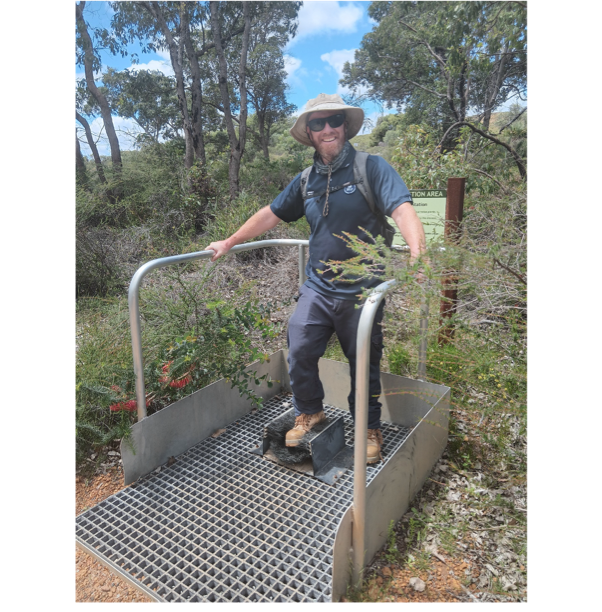
Arrive clean. Leave clean.
One of the simplest things we can all do is make sure we don’t accidentally carry soil from one bush area to another.
Before heading somewhere new, take a few minutes to check your boots, tyres, bikes, tools and other equipment and remove any soil or mud.
It’s a small action, but it can make a big difference.
The work we’ve been doing around Jurien Bay and Lesueur has been a great reminder that community engagement is about more than simply sharing information. It’s about building understanding, making connections and giving people the knowledge and confidence to help protect the places they care about.
And ultimately, that’s what we’re all working towards – growing knowledge and protecting country together.